What is in the copper chloride solution to degrade the aluminum foil?
When teaching the reactivity series, aluminium's protective oxide layer tin make it difficult for students to see its truthful reactivity in the context of metals reacting with aqueous solutions. A sit-in involving mercury(Two) chloride is described in Classic chemical science demonstrations and can be establish on the Practical Chemistry website. That experiment shows how removing the protective layer causes the aluminium to react with air. However, this demonstration shows its reaction in solutions that students are likely to accept already met. With a fiddling practice, information technology has the added wow gene of called-for with an eerie green flame that dances in the vessel as hydrogen is evolved.
Kit
The dancing flame effect tin be achieved in a variety of different ways. These instructions describe i reproducible method.
- 2 × 250 cmthree conical flasks. Aim for a generous neck width (I employ 34 mm internal diameter)
- Aluminium kitchen foil, 2 sheets ~twenty cm × 8 cm
- ~iii.5 g CuCltwo•2H2O (harmful if swallowed, solid may irritate the optics and pare, danger to the surround)
- ~3.5 g CuSO4•5H2O (harmful, solid may irritate the eyes and skin, h2o added to the anhydrous solid (sulfate Half dozen) produces heat danger to the environment)
- 50 cm3 1M HCl (low take a chance)
- 50 cm3 0.5M HtwoThen4 (irritant)
Preparation
Dissolve the copper(II) sulfate in the sulfuric acrid and the copper(II) chloride in the hydrochloric acid and ready the two solutions aside. Take a piece of aluminium foil approximately the width of the base of the conical flask and approximately 20 cm long. Ringlet information technology loosely just plenty to be able to fit through the neck of the flask – use a splint or spatula to gently push information technology home so it lies on its side on the base of the flask. Echo with the other conical flask. Accept a source of ignition nearby with some splints.
In front of the audition
When meeting the reactivity serial for the commencement time, information technology is likely that students will accept experimented with adding strips of metals to solutions of metal compounds, including copper sulfate. Show the students the solution of copper sulfate and explain that information technology too contains sulfuric acrid. Invite predictions of what may occur. Students may predict that hydrogen volition be produced from the reaction with acid and if they are already familiar with displacement reactions they may predict that the aluminium volition dissolve and copper will be formed. Few are likely to predict changes to the color of the solution without prompting.
When the mixture is poured on the aluminium foil, zero appears to happen. It is at this point that you may choose to tell students most the protective layer of aluminium oxide, which is stable enough in dilute acid that information technology prevents us from seeing aluminium's true reactivity. In the other solution, the chloride ions can disrupt this layer and reveal how reactive it can exist. Y'all may wish to point out that the effective concentrations of the two copper compounds are the same, as are the two acids (the formula masses of the 2 hydrated compounds are like enough that this is a fair approximation).
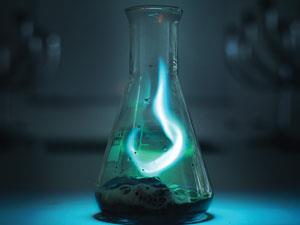
Add the copper chloride-muriatic acid mixture to the foil in the second flask and immediately light a splint. After a few seconds, the mixture volition begin to react vigorously and produce hydrogen gas. Hold the lit splint past the opening of the flask and the gas volition ignite. If you take timed it right, the flame will sink dorsum into the flask and trip the light fantastic toe within above the reaction with an eerie green colour from the copper. As the reaction slows, the flame volition extinguish itself. Swirl the flask to reinvigorate the reaction before attempting to relight.
The most common problem with this demonstration is finding that you lot tin can merely go one 'squeaky pop' manner ignition of the gas or that the flame retreats to the base of the flask and self-extinguishes. Further attempts to low-cal the hydrogen in the flask result in you lot dropping the splint down into the vessel, after which it promptly self-extinguishes every bit there is little air present. The reaction is proceeding as well slowly to continue feeding hydrogen at the appropriate charge per unit. Echo the reaction with a little more copper chloride in the mixture.
Teaching goal
The principal objective here is to show students how reactive aluminium is. The aluminium oxide layer protects the metal beneath from further reaction with air, water or acid. But chloride ions tin can ligate aluminium ions at the metal–oxide interface and break downward the protective layer, assuasive the reaction to keep.
The post-obit reactions are by necessity a 'good enough' explanation for this level as a range of aluminium species are involved. These are consistent with the level at which the demonstration is aimed, and with reactions that students may come up across subsequently in their school careers.
2Al(south) + 3CuCl2(aq) → 2AlCliii(aq) + 3Cu(southward)
2Al(s) + 6HCl(aq) → 2AlCl3(aq) + 3H2(g)
Disposal
All solutions can be washed down the sink with plenty of water. Pour the flask contents through a sieve to grab any large pieces of unreacted foil.
Further reading
- The existent reactivity of aluminium in either Practical Chemical science or T Lister, Classic Chemistry Demonstrations, p39. Imperial Order of Chemistry, 1996
- A demonstration from Periodic Table of Videos using an aluminium block casing is well worth watching
- The reaction of aluminium with copper salts
Safety
Vesture heart protection.
Source: https://edu.rsc.org/exhibition-chemistry/dancing-flames/2000045.article
0 Response to "What is in the copper chloride solution to degrade the aluminum foil?"
Post a Comment