Make Learning Fun Again Geometry City
Frequently Asked Questions:
Q1: What are some games on identify 2D shapes?
Ans:There are many games on SplashLearn website on 2nd shapes where you tin examination your knowledge on identification of 2D shapes, their backdrop and compare them as well. In SplashLearn you lot can observe "Geometry games" in tab "math games by topic" to play games on 2nd shapes.
Q2: What are some properties of 2D shapes?
Ans:The shapes which are apartment and can't be held in hand are 2d shapes. Other properties are based on their sides, vertices and diagonals. Search for SplashLearn page and observe "Geometry games" in the tab "Math Games by Topics" to have fun while playing games on 2nd shapes and their properties.
Q3: How is geometry used in real life?
Ans:Geometry means geo + measure meaning measurement of globe. Geometry plays a very of import function in our real life. First from simple 2d and 3D shapes, their properties, it has its application in imaging and graphics as well.
Q4: What are some games on partitioning shapes?
Ans:To empathise partitioning shapes, 1 must know about shapes. There are many games on partitioning shapes which you tin can explore in SplashLearn website. You can detect these games nether the section Geometry games in the tab "Math Games by Topics".
Q5: How exercise nosotros find area of shapes using unit squares?
Ans:To notice area of shapes using unit squares, you can trace the paradigm on a filigree paper formed of unit of measurement squares. The total number of squares within the tracing of shape gives the approximate surface area in square units.
Q6: What are different 3D shapes?
Ans:Cube, cuboid, sphere, cylinder and cone are some of the 3D shapes. To explore properties of 3D shapes, you tin can visit SplashLearn folio and play fun games of 3D shapes in Geometry games section.
Q7: What are positional words?
Ans:The words that depict the position of objects are called positional words. For example, summit, bottom, centre, upwardly, down, right, left, under are all positional words. To play games on positional words, you lot can visit SplashLearn page and explore Geometry games.
Overview of Geometry
Geometry is a science of shapes and space. It is considered as an of import field of mathematics as information technology offers its learner a deeper understanding of the world effectually them. Examples of geometric shapes tin can exist found in nature too equally in most areas of man-made creativity.
The study of Geometry and Spatial Sense develops such concepts and skills that play an important role in other areas. For example, the field of architecture requires an in-depth agreement of geometric shapes and their attributes. Geometrical agreement has also proved important in other domains of mathematics. For example, understanding area and volume involve manipulation of geometric shapes. As well, agreement multiplication and division using array require an understanding of geometric shapes and figures.
The kids are introduced to geometry math during early schoolhouse years. The geometry common core math standards involve an introduction to geometry in prekindergarten. Discovering geometry helps children develop deductive problem-solving skills.
Many researches accept shown that children learn better through games. In recent times, math games accept get pop. One of the nigh of import reasons to innovate learning games in Mathematical teachings is the excitement and enthusiasm it brings to the kids. Math games enable children to feel success and satisfaction and thereby, develop confidence in their newly-acquired skills. Mathematical field of geometry requires visualization for better understanding.
Progression of Geometry with Grades
Kindergarten: In kindergarten, children learn to identify and describe two- and three-dimensional shapes. They are able to identify the geometric shapes and names regardless of their orientation. They clarify and compare shapes of dissimilar sizes and attributes. They also learn to compose unproblematic shapes to course larger shapes.

Class i: In this course, children develop skills to reason with shapes and the attributes. They understand bones geometric shapes definition. They analyze shapes from their defining attributes, like number of sides. They compose ii dimensional and iii-dimensional shapes to make larger composite shapes. They acquire to partition rectangles and circle into equal shares. They learn the vocabulary related to partitionings like quarters, fourths and halves.
Grade 2: The kids learn to identify and draw shapes co-ordinate to the given attributes. They learn to describe shapes as per the specified number of faces or geometry angles. They are able to identify cubes, pentagons, hexagons, quadrilateral, and triangles. They also larn to sectionalization a rectangle into same-size squares. They and so count these squares to determine the size of the rectangle. The kids acquire to sectionalisation rectangles and circles into two to iv equal shares. They describe the partitioned shapes using the words like one-half of, third of, thirds, halves. They sympathize the wholes as 4 fourths, three-thirds, and 2 halves.
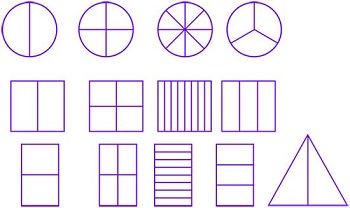
Grade 3: The kids understand the relationship betwixt shapes according to their attributes. They learn well-nigh the larger category shapes with shared attributes. For instance, the shapes with four sides are called quadrilaterals. They sectionalisation shapes into equal parts. They learn to express the surface area of each part as a unit fraction of the whole. For example, they partition a shape into 3 equal parts and describe the area of each part as ane/3 of the area of the whole. They likewise larn to find area and perimeter of a rectangle and other polygons.

Grade 4: The kids larn about points, line segments, geometric lines, rays and types of angles. The kids identify these in two-dimensional figures. They too acquire about parallel and perpendicular lines. They classify the figures on the ground of the parallel or perpendicular lines. They likewise classify the figures co-ordinate to the angles of specified size. Also, they larn almost the dissimilar triangles in geometry. The kids also learn about line of symmetry for a two-dimensional figure. They draw lines of symmetry and identify line-symmetric figures.

Grade 5: The kids are introduced to coordinate geometry. They learn to graph points on a coordinate system consisting of perpendicular number lines called axes. They correspond mathematical problems by graphing points on the geometry plane. They also larn to classify elementary geometry figures into categories and sub-categories on the ground of the geometric properties. For example, all squares and rectangles are quadrilaterals. All squares are rectangles. They learn to classify two-dimensional shapes in a hierarchy.

Learning Geometry through Manipulatives
The geometric concepts tin can be learned in several ways. The geometric learning can exist done through manipulatives, physical objects, illustrations, and diagrams. For effective understanding, the kids should accept the opportunity to manipulate solid models. The geometric learning should non merely be based on pictures and diagrams. The learning should encourage kids to represent their own mathematical ideas. This tin can be done using pictures and concrete models.
The geometric concepts tin be learned in several means. The geometric learning tin be washed through manipulatives, concrete objects, illustrations, and diagrams. For effective understanding, the kids should have the opportunity to manipulate solid models. The geometric learning should not merely exist based on pictures and diagrams. The learning should encourage kids to stand for their own mathematical ideas. This tin be washed using pictures and physical models.
Geometric Solids:
This is an effective manipulative that can be used for teaching kids from prekindergarten to grade ii. The kids find it easier to learn 2D shapes than 3D geometric shapes. Ane reason for this is that names of 3D shapes are used less oft in day to day routine. Another reason is that in almost classroom teachings the 3D geometric shapes are taught through drawings. Unfortunately, many kids cannot understand these 3D drawings. A drawing of a sphere looks similar a circle. This makes information technology difficult to empathise the difference between a sphere and a circle. Therefore, to teach geometric shapes 3D to the kids, geometric solids are great.
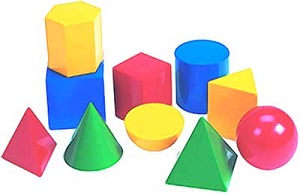
The kids tin can touch, hold and manipulate these objects. It gives them a clearer understanding of the attributes of the 3D geometric shapes.
Tangrams:
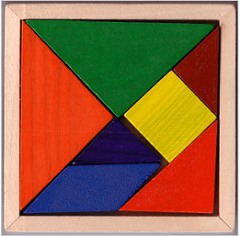
Tangrams can exist used to teach kids well-nigh the spatial human relationship. It is apt for kids from form i to grade iv. It is a Chinese puzzle consisting of vii tans or shapes. The kids have to adjust these shapes to recreate a given shape. The rule of the puzzle requires all the shapes to exist used without overlapping. Playing with tangrams help kids amend their spatial agreement. They too learn about spatial rotation skills and vocabulary associated with it. The kids also learn to calculate areas without learning the formulas.
Larn Geometry through Games
Some interesting geometry games are given beneath:
Search and Evidence – For grade 3 and to a higher place
Game Plot
This game requires 4 or more players and is usually played with an even number of players. The game is played in teams with each squad having at least 2 players each. Before the start of the game, a bowl is filled with paper chits, which take unlike shapes written on them. Each team goes in turns. 1 player from the squad will pick a chit at random. He/She will read the shape written on information technology without speaking it aloud. Then he or she will describe the properties of the shape to his/her team member. The team members will have to judge the name of the shape. E.chiliad. – If the shape written on the chit is foursquare, then the player can say that the shape has 4 sides and all sides are equal.
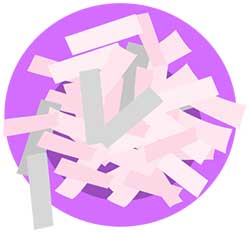
The squad which is able to guess the shape in the to the lowest degree amount of time wins the game. This game particularly helps the kids call back the dissimilar characteristics of each shape. And too gain confidence in terms of communicating the cognition gained past them as office of learning geometry.
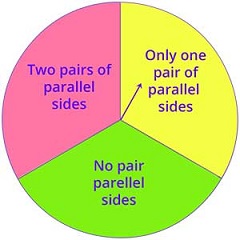
Classifying Quadrilaterals - For course three and above
Game Plot
This requires 2 or more than players. Each actor, in turns, needs to push the bicycle for rotation. When the wheel stops the pointer will bespeak to one of the three sections on the wheel. At that place is a geometrical aspect mentioned on each section. The player volition need to mention all the 2D geometry shapes names they can relate with that aspect. East.g. If the wheel stops at "Only i pair of parallel sides" he/she can listing trapezoid as the correct shape. This game guides the children to relate the properties with each of the shapes and as well help them visualize these properties. The game invokes healthy competition between them along with improving their learning's for geometrical shapes.
Source: https://www.splashlearn.com/geometry-games
0 Response to "Make Learning Fun Again Geometry City"
Post a Comment